

Print Finishes
We offer a comprehensive print finishing service. Take a look at the different types of finishing we offer. Or call us on 01202 828877 for our recommendations on the most appropriate print finishing for your project.
We can add a range of print finishes to your case-bound books to enhance the look, feel and overall impact of the finished product. Options include:
-
Foil blocking which applies metallic or coloured foil to the cover for a premium decorative detail
-
Embossing which raises part of the design to create texture and depth
-
Debossing which presses the design into the cover for a subtle, refined effect
-
Lamination to protect the printed cover and add a matt, gloss or soft-touch finish
-
Spot UV cover finishing to highlight selected areas with a clear, glossy coating.
These finishes can be used individually or combined to create a distinctive, high-quality result.


Collating
Collating is the process of gathering printed sheets or sections into the correct order ready for binding or finishing. It ensures that every page is arranged accurately and consistently before the next stage of production.
Collating is an essential part of producing booklets, books, manuals and other multi-page publications. Compared to manual sorting, professional collating provides greater speed, accuracy and efficiency, helping to ensure a high-quality finished result.
Scoring / Creasing
Scoring / creasing is the process of creating a precise line in the paper or card to allow it to fold cleanly and accurately. It helps prevent cracking on heavier stocks and ensures a neat, professional finish.
Scoring and creasing are often used for covers, greetings cards, brochures, folders and other folded printed items. Compared to folding without preparation, it provides a cleaner result and improves both the appearance and quality of the finished piece.


Folding
Folding is the process of accurately folding printed sheets into the required format, ready for binding or finishing. It ensures clean, consistent folds and helps prepare sections for the next stage of production.
Folding is commonly used for book sections, brochures, leaflets and other printed materials. Compared to folding by hand, professional folding provides greater speed, precision and consistency, helping to achieve a high-quality finished result.
Cutting
Cutting is the process of trimming printed sheets or finished publications to their required size with clean, accurate edges. It ensures consistency throughout the job and gives the final product a neat, professional finish.
Cutting is used for books, brochures, leaflets, cards and many other printed materials. Compared to manual trimming, professional cutting offers greater precision, speed and accuracy, helping to achieve a high-quality finished result.

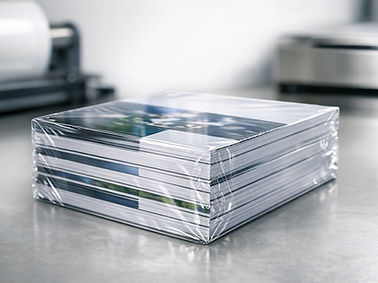
Shrink wrapping
Shrink wrapping is the process of enclosing finished printed materials in a clear protective film to keep them clean, secure and well presented. It helps protect items from dust, handling and moisture while giving them a neat, professional finish.
Shrink wrapping is often used for brochures, booklets, books and other printed products that need to be packed individually or in sets. Compared to leaving items unwrapped, it provides added protection, improved presentation and greater convenience for storage and delivery.
Round cornering
Round cornering is the process of trimming the corners of printed materials to create a smooth, curved finish. It gives the final product a neater appearance while also helping to reduce wear on the edges.
Round cornering is often used for books, notebooks, cards, menus and other printed items where both presentation and durability are important. Compared to square corners, it offers a softer, more refined finish and can improve the overall feel of the product.


Bench work
Bench work is carried out by hand and includes the careful finishing, assembling and checking of printed materials and bound products. It is used for jobs that require accuracy, attention to detail and a more manual approach than machine finishing alone.
Bench work is often used for hand assembly, inserting components, tidying finished products and completing specialist finishing tasks. Compared to fully automated processes, it offers greater flexibility and allows for a more precise, hands-on finish.
Unique Finishes
We can create bespoke finishes for highly creative or unusual projects, developing solutions in-house or working with our trusted specialist partners. This approach is ideal when you want the finished piece to feel distinctive, memorable and carefully considered.
For example, we developed a crocodile edging finish for a fashion book, giving the pages a textured, newspaper-like edge that contrasted beautifully with the refined cover. It created a striking final result and helped turn the book into something truly individual.
